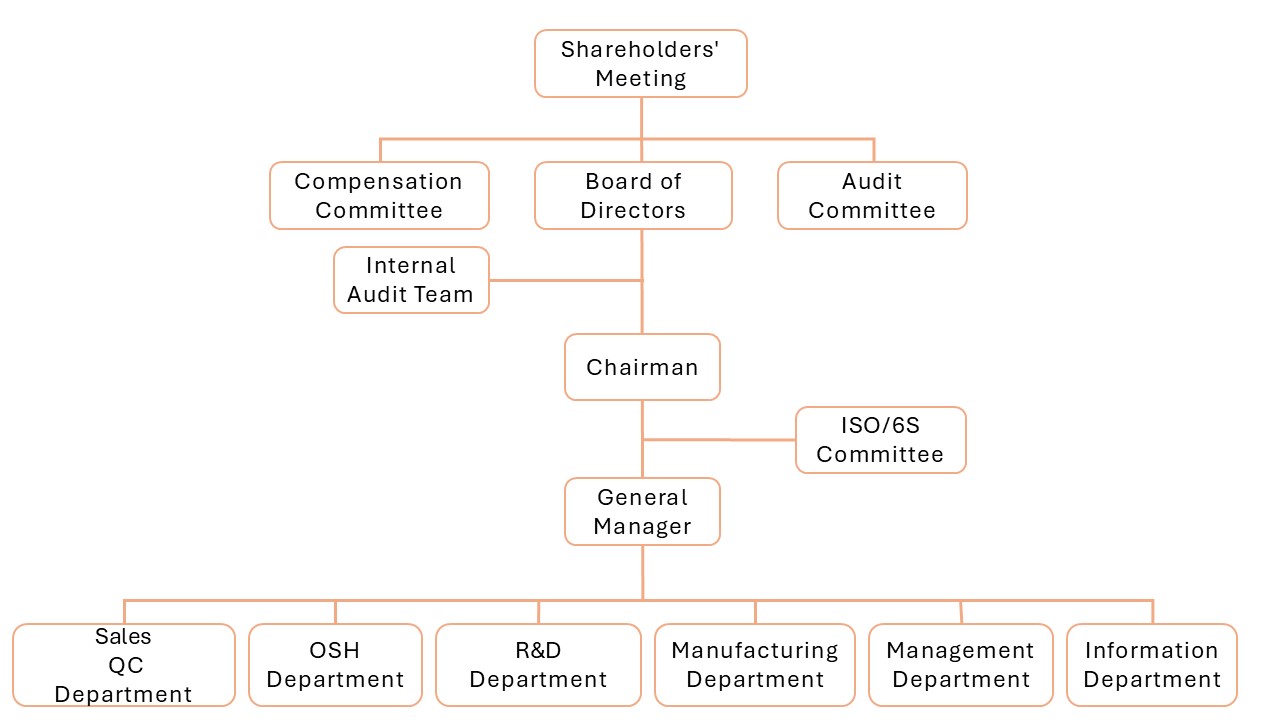
| Department |
Key Responsibilities |
| Compensation Committee |
|
Regularly review the Compensation Committee’s organizational rules and propose amendments. |
| |
Establish and periodically review policies, systems, standards, and structures for annual and long-term performance goals
and compensation for directors and executives. |
| |
Periodically evaluate directors’ and executives’ achievement of performance goals and determine individual
compensation details and amounts. |
| Audit Committee |
|
Ensure proper presentation of the company’s financial statements. |
| |
Selection (appointment or dismissal), independence, and performance evaluation of certified public accountants. |
| |
Effective implementation of internal controls and compliance with relevant laws and regulations. |
| |
Manage existing or potential company risks. |
| ISO & 6S Committee |
|
Establish ISO operational procedures and conduct audit operations. |
| General Manager's Office |
| |
Oversee company management and report to the Chairman. |
| |
Execute Board resolutions, annual plans, and investment proposals. |
| |
Supervise departmental operations. |
| |
Approve basic management policies. |
| |
Appoint or dismiss managers, except those under the authority of the Board or Chairman. |
| |
Approve employee wages, benefits, and disciplinary systems; decide on hiring and termination. |
| |
Preside over important company meetings. |
|
| Internal Audit Team |
| |
Establishment, revision, and implementation of internal audit procedures |
| |
Formulation and execution of the company’s annual audit plan, tracking abnormal issues or processes requiring improvement, and assisting in driving corrective actions. |
| |
Conduct periodic and ad hoc audits, issue audit reports, and verify improvements for identified issues. |
| |
Formulate and execute the company’s internal inspection plans. |
| |
Carry out regulatory reporting requirements, supervise and review budgets, and handle tasks assigned by the Board of Directors. |
|
| Information Technology Department |
| |
Plan, arrange, and manage IT hardware and software operations, data backup, and system troubleshooting. |
| |
Program modification, development, and user requirement analysis. |
| |
Database management, database backup, and network maintenance. |
|
| Manufacturing Department |
| |
Plan production workspace layout and environmental requirements. |
| |
Plan manpower requirements for operations. |
| |
Train and manage production personnel. |
| |
Control and improve production progress and quality. |
| |
Plan, execute, and improve manufacturing procedures and standard operations. |
|
Sales
QC
Department |
| |
Develop new customers and maintain existing client relationships. |
| |
Quotation, order review, and acceptance. |
| |
Plan and liaise on external cooperative projects. |
| |
Coordinate production and sales communication. |
| |
Handle after-sales services. |
| |
Implement and promote projects (new products). |
| |
Conduct market and industry research and develop strategies. |
|
| OSH Department |
|
Conduct occupational safety and health training and implement safety plans. |
| |
Handle emergency occupational safety and health issues. |
| |
Establish occupational safety and health processes, rules, and forms. |
| R&D Department |
|
Plan processes for new products. |
| |
Improve manufacturing process technologies. |
| |
Develop new materials and enhance material properties. |
| Management Department |
|
Prepare annual budgets and perform variance analysis and control. |
| |
Handle accounting and tax matters. |
| |
Manage funding acquisition and allocation. |
| |
Evaluate, propose, and execute investments. |
| |
Execute regulatory reporting requirements. |
| |
Oversee company-wide raw material procurement and reduce procurement costs. |
| |
Manage fixed assets, office safety, hygiene, and provide other support. |
| |
Handle human resources recruitment, transfers, promotions, salary policies, workforce structure, and performance
management. |
| |
Implement employee welfare and training programs. |